Not pushing down just placing your hands on the keys; Holistic Pianism (2)

Updated: Mar 17
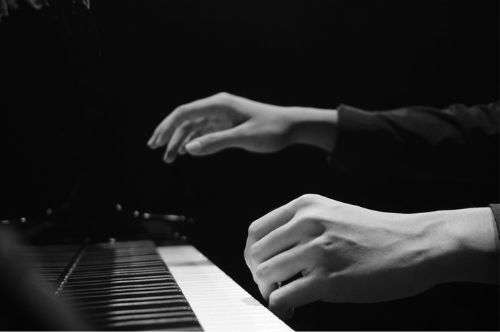
The biggest misconception about playing the piano is the idea that we have to push the keys down to produce sound.
I understand why this image is so strong.
We look at the piano so many black and white keys and when we “push” one it goes down and sound comes out.
It’s hard not to think of it as pushing.
But have you ever wondered how much weight is actually needed for a key to go down?
Most piano keys are regulated to descend with about 50 grams of weight. Just 50g.
Have you ever tried to feel how little 50g is?
If you place a single finger on a kitchen scale it can easily read a few hundred grams. To bring it down to 50g you would have to lift your finger quite noticeably. It can be surprising.
It’s that light.
The piano’s mechanism is simple: when a key goes down the hammer strikes the string. That’s it.Unless you release the key and let the damper return to stop the vibration the string will keep sounding. And once the key has reached the keybed adding more weight won’t change the sound that has already been produced.
So continuing to press into a key that has already bottomed out is unnecessary and it can easily invite tension.
In a slow piece it may not cause obvious technical problems. You just get tired sooner.But in fast passages if your muscles stay engaged without release tension accumulates and movement becomes restricted.
Then your hands and arms start to feel blocked and it’s easy to assume you’re missing some technical skill.
Maybe in some ways. But often the biggest issue is simpler: our approach to the keys.
If you can reorganize your image if keys are not like elevator buttons you can begin to replace pushing down with something else placing your hand on the key surface like placing a cup on a tray.
This is one of the quiet secrets of using arm weight at the piano without building up tension.
There’s more to cover.
Over the past year I’ve learned so much about technique and I’ll share it with you.
Let’s take it one by one step by step.

© 2026 PianoBee
All rights reserved.
This work may not be reproduced without permission.
These reflections grow out of ongoing work at the piano, in teaching, and in performance.


Comments